
What Is a Thesis Statement?
A thesis statement is the central idea or main claim on which a paper, such as an essay, research paper, dissertation or report, is based. It should alert the reader as to what your paper is about, the presentation you are making, and what they will expect in the subsequent sections. Your thesis is a statement that is presented in a brief sentence or two, typically at the end of the introduction, that tells the reader what your argument or idea about the paper will be. It introduces a specific claim, rather than just a topic, which could be developed and substantiated during the course of the essay.
For example:
Weak Thesis:
- The majority of students are actively using social media.
- This statement merely presents a fact and does not establish an argument.
Strong Thesis: University students use social media not only to communicate but also as a means of collaboration; however, when used excessively, it can impact the students’ academic performance by distracting them from studying and concentration.
This version makes a position and presents key points that will be covered in the essay.
A Strong Thesis Statement has the following qualities. A Strong Thesis Statement will have the following qualities.
Characteristics of a Strong Thesis Statement
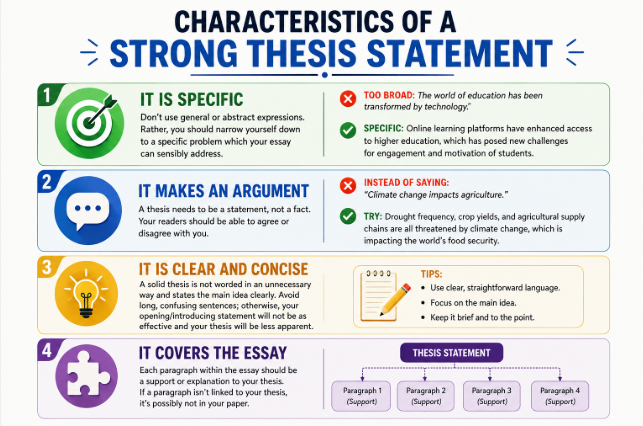
1. It Is Specific
Don’t use general or abstract expressions. Rather, you should narrow yourself down to a specific problem which your essay can sensibly address.
Too Broad: The world of education has been transformed by technology.
Specific: Online learning platforms have enhanced access to higher education, which has posed new challenges for engagement and motivation of students.
2. It Makes an Argument
A thesis needs to be a statement, not a fact. Your readers should be able to agree or disagree with you.
Instead of saying:
“Climate change impacts agriculture.
Try:
Drought frequency, crop yields, and agricultural supply chains are all threatened by climate change, which is impacting the world’s food security.
3. It is clear and concise
A solid thesis is not worded in an unnecessary way and states the main idea clearly. Avoid long, confusing sentences; otherwise, your opening/introducing statement will not be as effective, and your thesis will be less apparent.
It Covers the Essay
Each paragraph within the essay should be a support or explanation of your thesis. If a paragraph isn’t linked to your thesis, it’s possibly not in your paper.
Steps to Write a Strong Thesis Statement
Here are some steps to help you develop a thesis statement.
- Step 1: Understand the Assignment
Read the essay question thoroughly and determine what is being requested. Decide between arguing, comparing, analysing, evaluating and explaining.
- Step 2: Narrow Your Topic
Many times, broad topics will elicit weak thesis statements. Pick a particular component that you can go into detail on.
- Step 3: Take a Position
Think about the beliefs you have on the topic. Note that you are making a statement, not a description, in your thesis.
- Step 4: Support Your Claim means providing evidence to back up your answer.
Think about the key ideas or facts you’ll use to back up your proposal. These ideas may be the body paragraphs of your essay.
Now that you’ve written it, you’ll need to revise it.
As you are writing, you may change your understanding of the topic. Feel free to change the thesis to reflect the final argument of your paper.
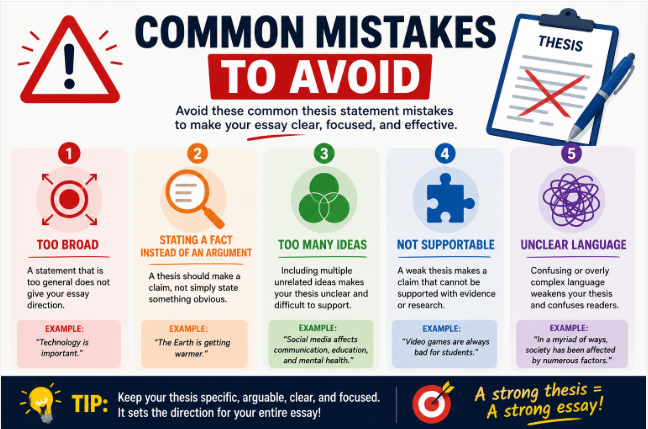
Common Mistakes to Avoid
- Other students will have similar mistakes in their thesis statements.
- A broad or general statement.
- A statement of a fact, not an argument.
- Adding several ideas that do not relate to each other in a single sentence.
- Claiming something that is not backed by evidence.
- Using abstruse or involved vocabulary.
Addressing these errors at the beginning will ensure that you have a better introduction to your text that you can concentrate on.
Final Tips for Success
- As you are preparing to hand in your paper, you should ask yourself the following questions:
- Does my thesis clearly state my answer to the assignment question?
- Does it address a specific rather than a general issue?
- Is there a clear argument expressed?
- Do I have evidence to support this?
- Does each paragraph relate to my thesis?
- If the answer you gave to each question is “yes,” you are probably using a good thesis statement.
Conclusion
A good thesis is the guide to your entire essay. It offers a well-chosen organisation of the ideas and a clear understanding of your main argument to the reader. Making your thesis specific, arguable, concise and evidence-based puts you on a good footing for academic writing. Keep in mind that the thesis is a work that can be planned, drafted and revised. Regular practice will help you master the skill of creating clear and effective thesis statements, which will improve the quality of your essays and research papers.