
Introduction
Academic writing is based on trustworthy evidence. Your work is either going to run into plagiarising others’ work, or your sources are going to suffer. In an essay, dissertation, research paper, or case study, your sources are going to make a huge difference to your arguments; otherwise, you are at risk of plagiarising someone else’s work. With several thousand hits brought up in seconds, it’s difficult for many students to tell whether information they find online is reliable or not. Misusing or misleading information can lessen the effectiveness of your work, diminish academic credibility, and even result in academic failure. Researching the tools for finding good, reliable academic sources is a critical/important research skill. This blog provides practical advice on how to locate good, reliable sources and determine the credibility of sources, as well as how to organise sources effectively to enhance the effectiveness of academic writing.
The Importance of Good Sources
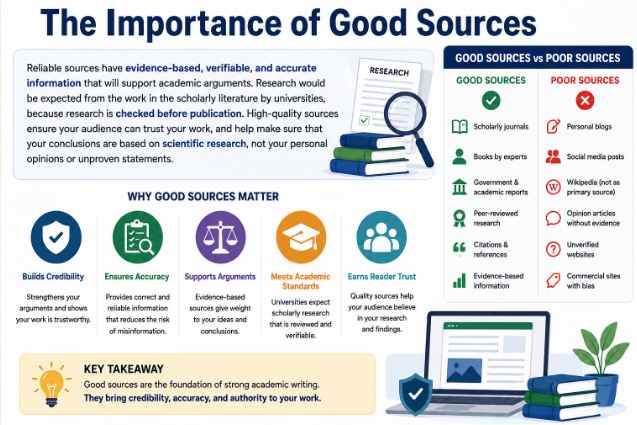
Reliable sources have evidence-based, verifiable, and accurate information that will support academic arguments. Research would be expected from the work in the scholarly literature by universities, because research is checked before publication. High-quality sources ensure your audience can trust your work, and help make sure that your conclusions are based on scientific research, not your personal opinions or unproven statements.
Begin with Academic Databases
Scholarly databases are the best places to look for academic papers as opposed to just a Google search. The databases feature journal articles, conference papers, books and research reports authored by industry professionals and peer-reviewed.
Examples of some of the most used databases are:
- Google Scholar
- JSTOR
- ScienceDirect
- SpringerLink
- Taylor & Francis Online
- Wiley Online Library
- Emerald Insight
- ProQuest
These databases are usually available through the library web page of most universities for free. The more you use the University resources, the more likely you are to find relevant, good research.
Authority
- Who is the author?
- What do they have that you need?
- Are they linked to a reputable University or Institution?
Accuracy
- Do claims have evidence to back them up?
- Are there references to back up the article?
Purpose
- Does the article convey information, or persuasion?
- Is there any apparent bias?
- Using these questions will help to decide whether a source is suitable for an academic project.
- Ensure you search for peer-reviewed journal articles.
Usually, a peer-reviewed article is regarded as the best research in the academic world. The study is reviewed by scholars in the same field before it can be published to make sure that it upholds high academic standards. This reviewing process makes the research more accurate and reliable and improves the overall quality of the research.
When you are searching in a database, consider using the following filters:
- Peer Reviewed
- Scholarly Journals
- Full Text Available
- Publication Date
Review Citations and References
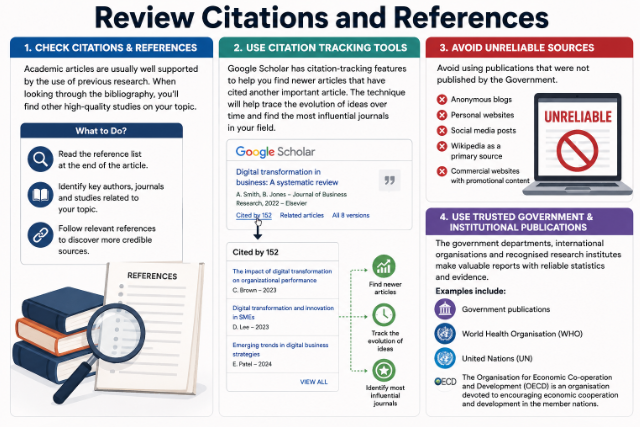
Academic articles are usually well supported by the use of previous research. When looking through the bibliography, you’ll find other high-quality studies on your topic.
Likewise, Google Scholar has citation-tracking features to help you find newer articles that have cited another important article. The technique will help trace the evolution of ideas over time and find the most influential journals in your field.
Avoid using publications that were not published by the Government.
The government departments, international organisations and recognised research institutes make valuable reports with reliable statistics and evidence.
Examples include:
- Government publications
- World Health Organisation (WHO)
- United Nations (UN)
The Organisation for Economic Co-operation and Development (OECD) is an organisation devoted to encouraging economic cooperation and development in the member nations.
Avoid Unreliable Sources
Avoid certain websites, except when they are specifically needed in order to be analysed.
Examples include:
- Anonymous blogs
- Personal websites
- Social media posts
- Wikipedia as a primary source.
- Commercial websites with promotional material
While Wikipedia is a good start to the concepts of a subject, students should refer to the original scholarly sources found in the reference section of Wikipedia, rather than directly quoting Wikipedia.
Organise Your References
References are managed and managed fully from the outset of research to save time when it comes time to write. Citation management software is used to save, organise and automatically format references to a required style.
Conclusion
Academic writing is about finding reliable sources among many important ones. Students can create more robust assignments by citing sources properly and from scholarly databases, crediting sources appropriately, prioritising peer-reviewed, authoritative institutional publications, and arranging their references effectively. The research skills cultivated in these exercises will also enhance student academic success and build critical thinking and information literacy skills that will be useful in post-secondary education and throughout one’s career. Taking the time to locate high-quality sources will result in high-quality, well-supported, and scholarly writing.