
Being able to construct sentences that are longer or use more advanced vocabulary is not enough for successful writing. Planning your ideas is crucial in any writing situation, from a school paper to a business report, a blog to a professional e-mail. One of the most basic writing elements is that of a paragraph structure. A paragraph is an organised and coherent way of writing to enable your readers to follow your ideas and keep your writing clear, coherent and persuasive. you have a clear idea of how these factors all work together, you’ll be able to increase the quality of your writing and make the reader’s experience better.
What Is a Topic Sentence?
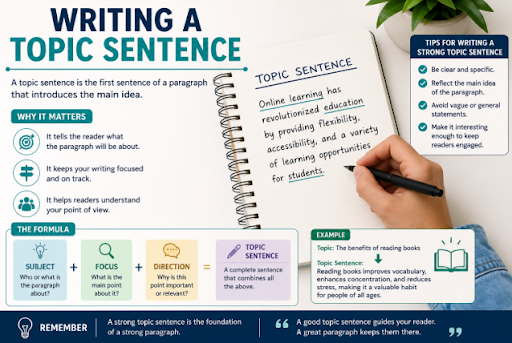
A topic sentence is the first sentence of a paragraph that presents the topic or the main idea of the paragraph. Provides a guide – tells readers what the paragraph is about. As you know, the focus and coherence of a paper are especially communicated by topic sentences in academic writing. The purpose of the paragraph may not be obvious to the reader, or the paragraph may not be related to the rest of the writing without a topic sentence. If writing on the advantages of online learning, the sentence could be: “Since learners are provided more flexibility in online learning, it has revolutionised the education sector.” This sentence immediately makes readers understand the explanation of the paragraph. The rest of the sentences should then expand this sentence, and not come up with new information.
Supporting Ideas: Building a Strong Paragraph
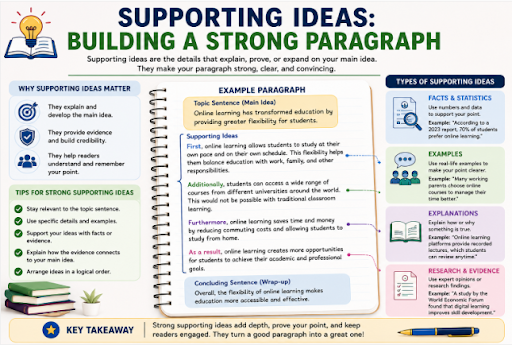
Once you’ve presented the main idea, you will need to give supporting ideas. These details are ones that explain, justify or elaborate on the topic sentence. These can be facts, examples, statistics, research findings, explanations, or real-life experiences to provide supporting ideas. For instance, in the context of online learning, there could be supporting sentences that comment on the flexible schedules that give students opportunities to work while attending school, cut commute time, and attend courses at various locations. Any supporting ideas must be in tune with the topic sentence. Just as anything else, it is possible to add extraneous details that could cause confusion and make the paragraph less effective.
Creating Logical Flow
The ideas should flow smoothly, and a clear topic sentence and strong supporting information should still feel connected to each other even if the supporting information is well-developed. A strong flow makes it easy to “read” the paragraph and keeps the reader focused on the paragraph. The most basic technique of enhancing flow is to learn how to use transition words and phrases. Repetition of key terms, nouns, verbs, and pronouns also helps to create a natural connection between sentences. For instance, many university learners opt for online learning methods due to their flexibility, and recorded lectures enable students to go back to learn challenging concepts at their own pace, leading to increased confidence in the tricky subjects.
Bringing the Three Elements Together
The best paragraphs have topic sentences, support, and connect ideas together. Every sentence carries a clear message/purpose and builds toward that message. Writers consider a paragraph to be a small essay: opening, supporting, and closing it. “This can be a lot easier to accomplish if planning occurs before the written composition. Writing an outline helps writers to determine the main idea, to choose the supporting details, and to sequence ideas. When editing, reviewing each paragraph one at a time allows you to make sure each sentence helps to include the overall idea and that transitions between the ideas are effective.”
Common Mistakes to Avoid
- While writing a paragraph, many writers encounter difficulties due to the fact that they try to state lots of ideas in one paragraph.
- This tendency to create wordy paragraphs often creates the problem that paragraphs will be unfocused and follow no pattern whatsoever.
- Another error students often make is failing to have a topic sentence, so that the reader doesn’t know the purpose of the paragraph.
- Proofreading frequently can also be able to let one catch any abrupt transitions, repetition or sentences that fail to advance the purpose of the paragraph.
Final Thoughts
Knowing how to write a paragraph is a key writing skill for all writers. The main idea is introduced in the first sentence of a topic sentence(s), supporting ideas explain and provide evidence for the main idea, and the ideas are well organised so that the reader can easily follow the discussion. All three are combined to form clear, engaging and persuasive paragraphs. Whether you’re about to write a term paper, a report, or publish a text online, you will benefit from spending some time crafting a good paragraph structure that will make it easier to communicate with your readers and make your writing more effective. Strong paragraphs are not just information presenters; they are rolling out your ideas with confidence, clarity and purpose.