
One of the core competencies of students who are going to higher education is academic writing. It has little in common with a kind of writing employed in everyday communication, like texting, posts on social media, or informal dialogues. Academic writing is often perceived as a difficult task by many beginners, as it demands a methodology, logical thinking and evidence.
Understanding Academic Writing
Academic writing may be defined as an official form of writing used in higher educational institutions and other academic settings. It is mainly used to convey ideas, arguments and research findings in a clear, logical and structured manner. Academic writing, unlike casual writing, is not founded solely on personal views but on evidence from reliable sources such as books, journal articles, and research studies.
The Academic writing tone is one of the most crucial elements of academic writing. Authors should not use slang, shortenings, and very informal language. To take a case in point, instead ofstating that many people think that way, an academic writer would say that several researchers argue.
Figure 1: Understanding the Concept of Academic Writing
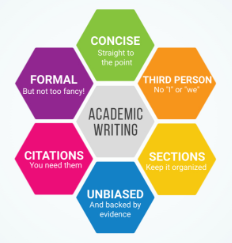
The other characteristic of academic writing is its clear structure. The majority of academic writings are structured according to the general template consisting of an introduction, body paragraphs and a conclusion. The introduction is the introduction of the topic and the statement of the main argument or purpose of the writing. This argument is elaborated in the body paragraphs through the presentation of evidence, analysis and discussion. The final part is the conclusion that summarises the main points and supports the main idea.
Secondly, scholarly writing should be correctly referenced. A writer needs to credit the source in terms of citations whenever he employs the ideas of another writer. This does not only provide credit to the other researchers, but also supports the argument by the writer by following reference styles like Harvard or APA.
Key Characteristics and Types of Academic Writing
Scholarly writing is marked with clarity, accuracy and objectivity. Clarity is a way of stating ideas in a simple and comprehensible way. Authors need not use sentences that are too complicated and can mislead the reader. Precision is the right use of words, the words used should have precise meanings and there should be no ambiguity. Objectivity, however, demands writers to be impartial and use facts to argue but not feelings.
Figure 2: Types of Academic Writing
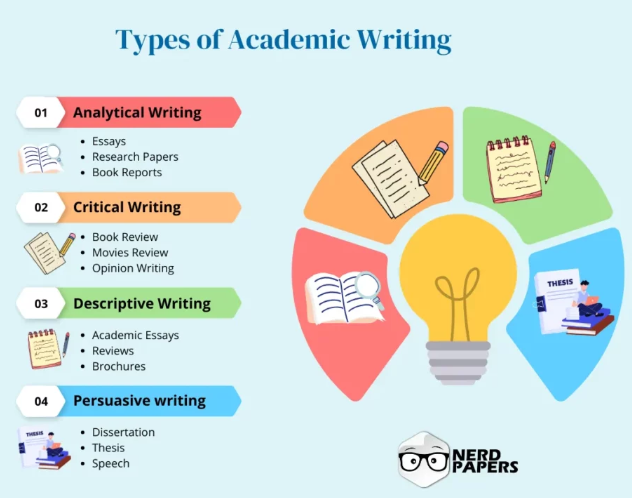
Academic writing has various kinds and they are used to fulfill various objectives. The simplest one is descriptive writing where the writer merely presents facts or information. The type is common when giving an introduction or when giving background information. Analytical writing takes it a step higher to explore and compare various ideas or views.
Another type of writing that is useful is the persuasive writing in which the author intends to persuade the reader regarding a certain opinion. This will involve formidable arguments backed by credible evidence. And lastly, critical writing is the most developed kind of academic writing.
Developing Academic Writing Skills
Academic writing is a process that is built with time and practice, particularly in beginners. Planning is one of the initial steps. It is best to plan ideas and make an outline before beginning to write. This assists with keeping a rational flow and makes sure that all the major issues are addressed. In the absence of planning, writing may turn out to be chaotic and incoherent.
Students can learn academic style, tone and structure of academic writing by reading academic books, journal articles and essays. This exposure assists them in knowing the development of arguments and effective evidence use.
Figure 3: Contextual Development of Academic Writing Skills
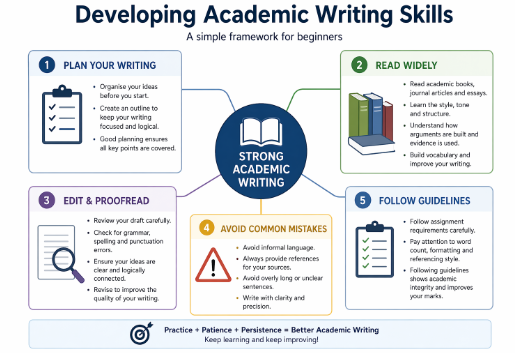
The editing and proofreading are as well fundamental components of the writing process. Once the work has been completed, writers are advised to go through their work to point out the mistakes in grammatical, spelling, and sentence construction. Amateurs should also remember about frequent errors, for example, one should not use informal language, may omit references, or write too long and sentences that are difficult to comprehend. These mistakes can be prevented to a large extent and make academic writing much more effective.
To recapitulate, academic writing is a critical skill that helps students convey ideas and interact with academic knowledge. It might seem challenging but with familiarity with its major characteristics, namely, the presence of formality, the logically organised structure, and fact-based arguments it becomes easier to learn. Through practice, planning and taking details, anyone can become a good academic writer and excel in their academic life.